Learn
Kidney Care at 16: Why Acting Before Symptoms Mattered for Breezy
For this month’s kidney care case, we are sharing the story of Breezy, a female domestic shorthair who will celebrate her 16th birthday on August 20, 2026.
In March 2025, routine senior bloodwork showed an SDMA of 19.3 µg/dL and BUN of 34 mg/dL. By January 2026, those values had decreased to 12.3 µg/dL and 27 mg/dL, respectively.
Breezy was still eating well, active, and showing no obvious symptoms when routine senior bloodwork revealed early kidney-related changes.
Her guardian, Jessica, had previously lost two beloved cats, Meeka and Wilbur. Her experience caring for Meeka through chronic kidney disease, followed by the loss of Wilbur, made her even more proactive about Breezy’s senior care.
“Breezy wasn't diagnosed after becoming seriously ill. Because I had previously lost my beloved cat, Meeka, to chronic kidney disease at age 17, I became much more proactive about monitoring kidney health as my cats entered their senior years.”
Jessica did not want to wait until Breezy looked sick. She chose to act while Breezy was still feeling well.
Breezy at a Glance

| Category | Details |
|---|---|
| Name | Breezy |
| Age | 15-year-old female domestic shorthair, born on August 20, 2010 |
| Kidney Care Status | Early kidney changes identified during routine senior monitoring |
| Care Routine Started | After routine senior bloodwork in early 2025 |
| Greycoat Routine | Greycoat Dr. Toru, Greycoat Probiotics, and Greycoat Intensive, as described by her guardian |
| Other Supplements | Digestive Enzymes: Animal Essentials, and Liquid Algae Oil with organic hemp seed oil and organic flaxseed oil |
Kidney Changes Found Before Symptoms Appeared
Breezy was still acting like herself when bloodwork showed early kidney-related changes.
Routine senior bloodwork in early 2025 showed an elevated SDMA, even though Breezy was still showing no obvious symptoms at home.
Jessica wrote:
“Although she was still feeling completely normal—with a healthy appetite, good energy, and no obvious symptoms—I knew from experience that kidney disease can progress quietly before clinical signs appear.”
Rather than waiting for visible symptoms, Jessica worked with Breezy’s veterinarian and began a proactive kidney care routine.
Breezy’s Kidney-Related Lab Values
March 2025 Laboratory Results

January 2026 Laboratory Results

The following table reproduces Breezy’s recorded values from the two laboratory reports.
| Test Item | Mar. 2025 | Jan. 2026 | Observation |
|---|---|---|---|
| SDMA | 19.3 µg/dL | 12.3 µg/dL | Decreased to within the laboratory reference range |
| BUN | 34 mg/dL | 27 mg/dL | Decreased to within the laboratory reference range |
| Creatinine | 2.2 mg/dL | 2.4 mg/dL | Increased slightly to the upper end of the laboratory reference range |
In March 2025, Breezy’s SDMA was 19.3 µg/dL, above the laboratory reference interval of less than 15.0 µg/dL. Her BUN was 34 mg/dL, and creatinine was 2.2 mg/dL. By January 2026, Breezy’s SDMA had decreased from 19.3 µg/dL to 12.3 µg/dL. Her BUN had decreased from 34 mg/dL to 27 mg/dL.
Creatinine increased slightly from 2.2 mg/dL to 2.4 mg/dL, reaching the upper end of the laboratory’s stated reference interval.
Jessica understood that no single value could describe Breezy’s complete kidney health.
“Because kidney health is evaluated by looking at the complete clinical picture rather than any single value, we continue to monitor her closely with our veterinarian and will continue following her laboratory work over time.”
Breezy’s 4-Part Care Routine
① Moisture-Rich Diet and Hydration
Breezy does not eat dry food. Her guardian feeds Identity canned food and Identity human-grade fresh frozen recipes as part of a moisture-rich diet.
For Jessica, hydration is one of the most important parts of Breezy’s senior kidney care.
“Keeping her hydrated has always been one of my highest priorities because I know how important hydration is for supporting kidney health in aging cats.”
② Greycoat Research Routine
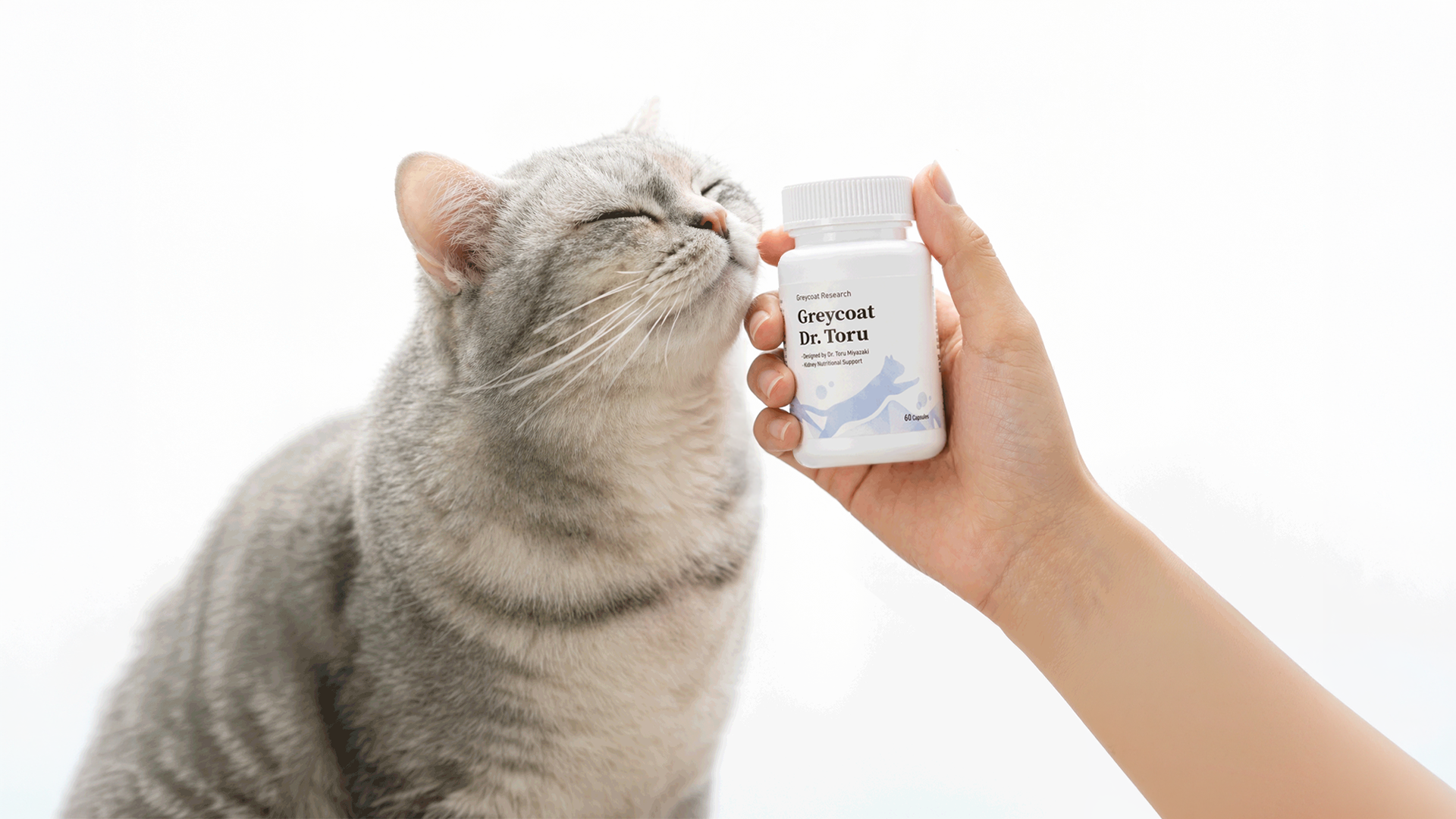
After researching kidney care options and speaking with Alex at Greycoat Research, Jessica decided to incorporate Greycoat products into Breezy’s daily routine as one part of her broader approach to long-term kidney care.
At the time of the review, Breezy was consistently receiving Greycoat Dr. Toru, Greycoat Probiotics, and Greycoat Intensive. Jessica continued this routine alongside a moisture-rich diet, hydration, veterinary monitoring, and other nutritional support rather than relying on any single product or intervention.
③ Daily Observation
Jessica pays close attention to Breezy’s appetite, hydration, weight, energy, behavior, and overall quality of life. She does not rely on one laboratory value alone.
For Breezy, how she feels and behaves every day is an important part of ongoing monitoring.
④ Veterinary Follow-Up
Breezy continues to receive routine veterinary care, bloodwork, and urinalysis. Her guardian also reported using digestive enzymes with meals and liquid algae oil with organic hemp seed oil and organic flaxseed oil.
Each part of the routine is considered within a broader approach to Breezy’s long-term senior care.
What Her Guardian Values Most
Breezy’s story is not about recovering from severe symptoms. She was already eating well and feeling normal when her guardian began proactive kidney care.
What Jessica values most is that Breezy continues to enjoy her daily life as she approaches her 16th birthday.
“Although I appreciate seeing encouraging laboratory values, what matters even more to me is how Breezy is doing every day.”
Breezy still has a healthy appetite. She enjoys her meals. She seeks out sunny windows for long naps. She follows Jessica around the house, asks for affection, and still has playful moments.
Jessica wrote:
“Most people would never guess she has early kidney disease because she continues to look and act like a happy, thriving senior cat.”
“For me, that is the greatest measure of success.”
Jessica is careful not to attribute Breezy’s overall condition or laboratory changes to any one part of her routine. For her, the value of the approach lies in continuing veterinary monitoring, nutrition, hydration, daily observation, and supportive care together over time.
What Breezy’s Guardian Learned
Breezy’s experience reinforced one lesson for Jessica. Kidney care does not have to begin only after a cat looks sick. Routine senior bloodwork gave her an opportunity to identify early changes while Breezy was still eating well, active, and feeling normal.
“The biggest lesson I've learned is that you don't have to wait until your cat looks sick to start caring for their kidneys.”
Her advice to other cat guardians is simple:
Do not wait for obvious symptoms. Schedule routine bloodwork as cats get older, pay attention to subtle changes, prioritize hydration and nutrition, and work closely with a veterinarian.
Most importantly, build a care routine that can be continued over time.
Why Breezy’s Story Matters
Breezy’s story shows what proactive kidney care can look like before obvious symptoms appear. Routine senior bloodwork identified kidney-related changes while Breezy was still eating well, active, and feeling normal. Rather than waiting for her condition to become visible at home, Jessica began working with her veterinarian and built a routine she could maintain over time.
Follow-up testing showed encouraging changes in SDMA and BUN, while creatinine remained an important value to continue monitoring. But for Jessica, the most meaningful result is not found on a laboratory report.
Breezy is approaching her 16th birthday while still eating well, seeking affection, enjoying sunny naps, following Jessica around the house, and having playful moments.
Jessica wrote:
“Today, as Breezy approaches her 16th birthday, I know there are no guarantees with aging or kidney disease. But I also know that choosing to be proactive has given me tremendous peace of mind.”
“Every additional healthy month with her feels like a gift.”
For Breezy and her guardian, kidney care did not begin because she looked sick. It began because her guardian chose not to wait.
※ Breezy’s results should be understood in the context of her complete care routine, including veterinary monitoring, repeat bloodwork and urinalysis, a moisture-rich diet, hydration support, daily observation, additional nutritional support, and the Greycoat Research routine. Changes in her bloodwork or overall condition cannot be attributed to any one supplement or part of her routine.
Individual results may vary. The laboratory values presented in this article represent one individual case and should not be interpreted as evidence that any product treats, prevents, or improves chronic kidney disease. Diagnosis and treatment decisions should always be made in consultation with a veterinarian.
Kidney care early
can make a difference for your cat.
Alongside a renal diet, add AIM-based daily care with Dr. Toru.