Learn
TT’s 8-Year Long-Term Stage 2 Kidney Care Record

TT is a spirited 10-year-old female cat living in Korea.
For many cat parents, a Stage 2 diagnosis can feel overwhelming.
TT’s story shows what long-term, consistent care can look like.
Her kidney values were already elevated as early as 2018, with creatinine above 2.0 mg/dL. At that time, her veterinarian recommended continued monitoring before making a formal diagnosis.
In 2019, her veterinarian confirmed her Stage 2 diagnosis.
This is not a story about one product creating one result.
It is a record of long-term care built through diet, hydration support, regular bloodwork, kidney-focused supplementation, and careful daily observation.
[See TT’s Kidney Care Routine]
Latest Bloodwork Result

In her latest bloodwork, TT’s results showed:
- Creatinine: 2.1 mg/dL
- BUN: 18 mg/dL
- Phosphorus: 3.6 mg/dL
- proBNP: 229.5 pmol/L
Based on creatinine, TT remains within the Stage 2 range.
Her numbers were not always stable from the beginning.
In the early phase of her care, her creatinine once rose to 2.9 mg/dL.
Later in her care journey, her proBNP level was also found to be elevated, so her heart-related indicators were monitored alongside her kidney values.
proBNP is a blood marker that may help assess cardiac strain in cats.
A high result does not automatically confirm heart disease, but it may suggest that further evaluation, such as an echocardiogram, should be considered by a veterinarian.
Why This Record Matters
Stage 2 kidney care should not be taken lightly.
In a major survival study of cats with naturally occurring CKD, cats classified as IRIS Stage IIb at diagnosis had a median survival time of 1,151 days, or approximately 3.15 years.
This median does not define what will happen to every individual cat.
But it helps show why long-term records like TT’s are meaningful.
TT’s kidney values were first identified as elevated in 2018.
Her Stage 2 status was confirmed by her veterinarian in 2019.
Today, her kidney care record spans 8 years.
While every cat’s journey is different, TT’s long-term record gives us a meaningful example of what consistent care and monitoring can look like over time.
A Long-Term Care Record Built on Consistency
This story is not presented as a cure or guaranteed outcome.
Kidney care does not end just because one bloodwork result looks good.
It would also not be accurate to say that TT’s record was created by one product alone.
TT’s case shows something more practical:
Long-term kidney care is about staying consistent, even when numbers become unstable.
When numbers change, the goal is not to panic or stop.
The goal is to reassess, adjust the routine, and continue care based on the cat’s condition.
TT’s record was built through regular monitoring, daily care, and years of consistency.
The 2019 Turning Point: Creatinine 2.9
In 2019, TT’s creatinine reached 2.9 mg/dL.
A single number can feel alarming.
But the meaning of that number can change when it is viewed together with the full history, appetite, hydration, symptoms, body weight, and other bloodwork markers.
At that point, TT’s routine was carefully reviewed and adjusted.
Her care was not based on one number alone.
It was adjusted by looking at her kidney values, heart-related indicators, appetite, hydration, body weight, and overall condition together.
TT’s Kidney Care Routine
TT’s routine was not built from one single method.
It is also not a routine that should be copied exactly for every cat.
Her care has been adjusted carefully based on her age, kidney values, cardiac marker, appetite, body weight, hydration status, and overall condition.
1. Diet
TT mainly eats Royal Canin Renal Select as her daily food.
For treats, she receives Greycoat Low-Protein Treats.
Rather than making sudden changes, the priority has been to maintain a routine that TT can comfortably accept and continue over time.
2. Hydration Support
TT’s daily hydration goal is about 200 ml.
Water is sometimes mixed with lickable treats.
When needed, small amounts are gently provided with a syringe.
This is never forced.
Hydration support is only given within the range TT can comfortably tolerate.
3. Kidney-Focused Supplements
As part of her daily routine, TT receives the Greycoat kidney care set:
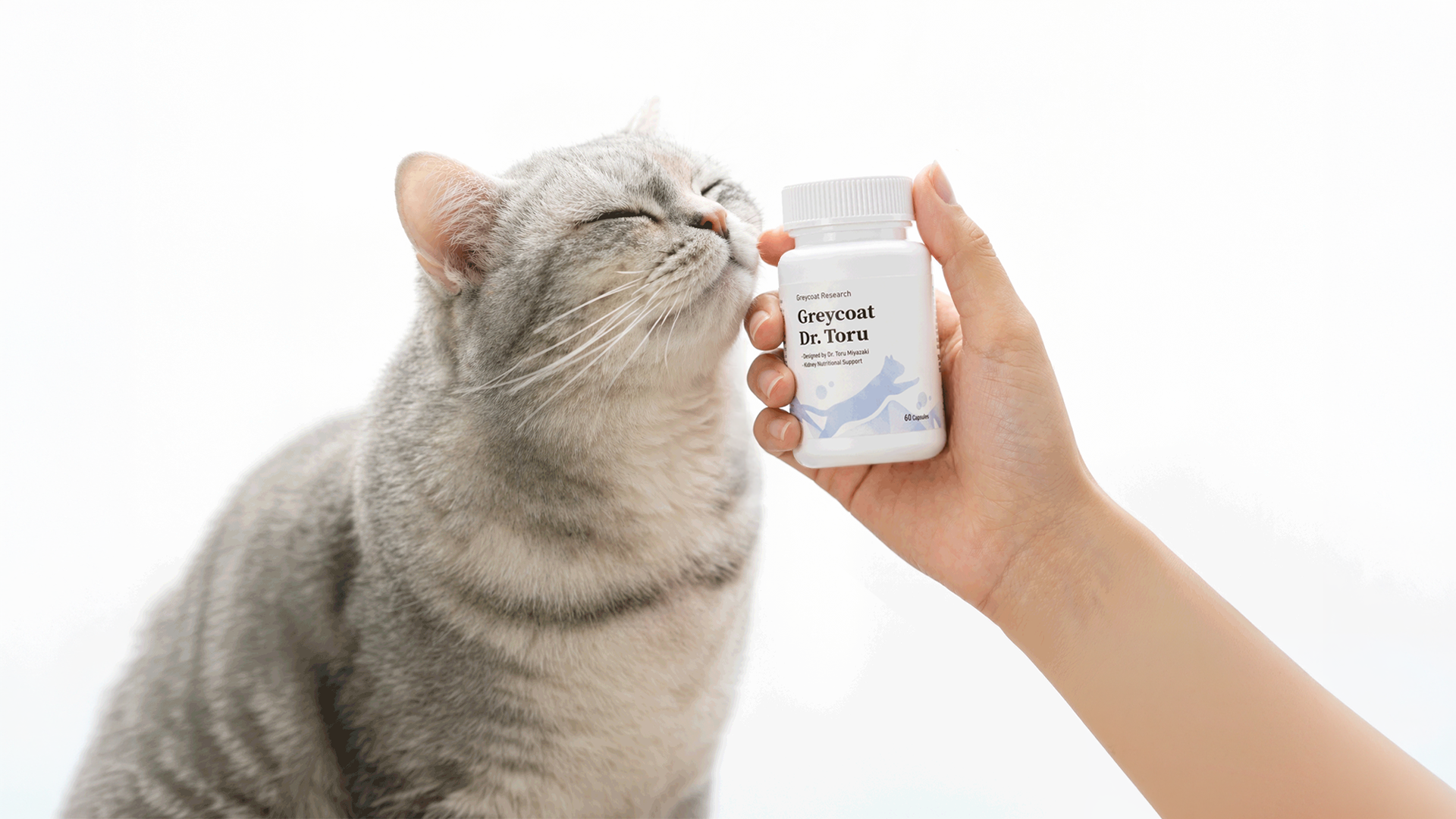
- Greycoat Dr. Toru
- Greycoat Intensive
- Greycoat Probiotics
Before bedtime, she also takes 1 capsule of Greycoat Calm as part of her evening routine.
The important point was never one single product.
TT’s care was built through a combination of diet management, hydration support, regular bloodwork, kidney-focused supplements, an evening Calm routine, cardiac marker monitoring, and close observation of appetite and body weight.
Hydration support, supplement routines, evening care, and heart-related monitoring should always be adjusted based on each cat’s condition and veterinary guidance.
TT’s Bloodwork Trend
| Test Item | May 2019 | Oct 2019 Peak | Mar 2023 | May 2026 |
|---|---|---|---|---|
| Creatinine mg/dL | 2.5 | 2.9 | 2.0 | 2.1 |
| BUN mg/dL | 23 | 21 | 20 | 18 |
| Phosphorus mg/dL | 4.4 | 4.2 | 3.7 | 3.6 |
| proBNP pmol/L | - | - | 390.2 | 229.5 |
Individual results may vary.
This case story does not imply a treatment effect, disease prevention, or guaranteed outcome.
An 8-Year Record Built by Routine
Today, TT is 10 years old.
She still eats, moves around, and runs on her cat wheel with energy.
It has now been years since the day her creatinine reached 2.9 mg/dL.
TT’s long-term stability was not created by one special method.
It was built through regular bloodwork, hydration support, careful diet management, cardiac marker monitoring, and most importantly, a daily routine that TT could comfortably continue for a long time.
A Simple First Step: Greycoat Dr. Toru
TT’s kidney care was built step by step over time.
If you are just beginning your cat’s kidney care journey, you do not need to start with everything at once.
Greycoat Dr. Toru is an easy way to add AIM-based daily kidney support to your cat’s current daily care.

[Start with Greycoat Dr. Toru]
Looking for a more structured routine?
[Explore the Greycoat Kidney Care Set]
To Cat Parents Walking a Similar Path
We hope TT’s long-term care record gives hope to other cat parents walking a similar path.
Every cat’s journey is different.
But consistent care, regular monitoring, and a routine that fits your cat can make daily kidney care more manageable.
To every cat walking a kidney care journey,
we are cheering for you.
P.S.
TT was reportedly very upset after her hospital visit.
She refused to make eye contact for two days. 😂
Reference
Boyd et al., Journal of Veterinary Internal Medicine, 2008.
Median survival for cats in IRIS Stage IIb at diagnosis was reported as 1,151 days.
Kidney care early
can make a difference for your cat.
Alongside a renal diet, add AIM-based daily care with Dr. Toru.