Hello from Greycoat Research,
When reviewing bloodwork for a cat with kidney disease, many guardians focus on creatinine and BUN.
These values are important.
But they are not enough on their own.
There is something else that should not be missed: electrolytes.
Why do electrolytes matter so much?
Because they can help reveal early signs of a serious complication.
If that complication is missed, kidney function may decline more quickly.
One of the most important complications is metabolic acidosis.
Metabolic acidosis means the blood is becoming more acidic.
In cats with kidney disease, this is a key complication to watch closely.
Once it begins, a cat’s condition can worsen faster.
Kidney care can also become much more difficult.
That is why bloodwork should not be limited to creatinine and BUN alone.
Electrolytes should also be checked carefully.
The most important values to watch are HCO3, K, and Cl.
In simple terms, if HCO3 is low, or if both K and Cl are high, metabolic acidosis should be suspected.
This is an important electrolyte pattern.
It may suggest that the blood is becoming more acidic.
Among these values, HCO3 is the most direct one to check.
If HCO3 cannot be measured because of hospital equipment limitations, look closely at K and Cl.
If both K and Cl are elevated, that may also be a sign that the blood is becoming more acidic.
This is not something to overlook in CKD bloodwork.
It is much better to catch these warning signs early.
Do not wait until the numbers have already worsened.
If metabolic acidosis is suspected, or has already developed, more intensive care may be needed.
In that situation, it is important to discuss options with your veterinarian.
These options may include sodium bicarbonate support or subcutaneous fluids with Plasma-Lyte.
At that stage, nutritional support may also need a closer review.
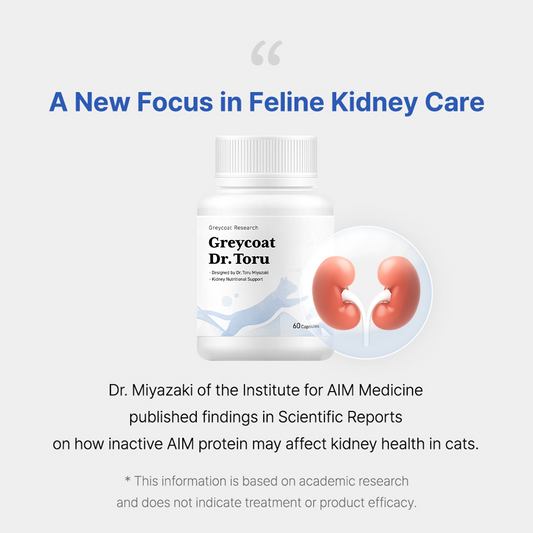
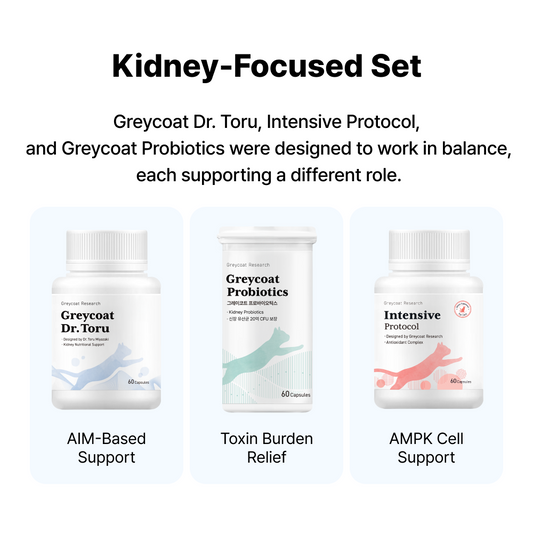
For cats at this stage, we suggest considering Dr. Toru + Appetite.
This combination may help support daily condition, appetite, and body weight maintenance in Stage 3 cats.
At your cat’s next blood test, please do not look only at creatinine and BUN.
Make sure HCO3, K, and Cl are checked as well.
When it comes to serious complications, early detection is always better.
Thank you,
Greycoat Research