알아보기
14-Year-Old Fred Wasn’t Himself: Early Kidney Signs That Were Easy to Miss
By Greycoat Research Care Team
Based on a care story shared by Fred’s guardian, Daryl

Fred’s bloodwork looked stable, but at home, he was vomiting, drinking more, and acting less like himself.
Fred is a 14-year-old male domestic shorthair who lives with his guardian, Daryl.
He was born on August 16, 2011.
Fred’s kidney care story did not begin with one dramatic bloodwork change.
Instead, it began with something many cat parents understand deeply:
Fred was not acting like himself.
- He had been vomiting.
- He was drinking more than usual.
- He was sleeping more.
- He was less interested in play and daily activities.
- He was also eating with less enthusiasm, even though he had always been a great eater.
At the same time, Fred’s main blood chemistry values looked stable.
In January 2026, Fred’s creatinine was 1.4.
One year earlier, in January 2025, his creatinine had also been 1.4.
His BUN was also unchanged.
It was 25 in January 2025 and 25 again in January 2026.
But Daryl knew Fred well, and the changes at home felt meaningful.
Daryl shared:
“Fred had been vomiting and drinking excessively for a few months prior, along with a greater loss of interest in his normal activities, such as play and spending time with his younger buddy, and he was also sleeping more. There was a noticeable loss of interest in eating as he normally would as well. Fred has always been a great eater!”
For Daryl, the appetite change stood out.
Fred had always loved food. So when he became less interested in eating, it felt like something worth paying attention to.
Fred’s story is an important reminder that early kidney care is not always about one bloodwork value alone.
Sometimes, the first signs appear in daily life.
Key Takeaways from Fred’s Case
In Fred’s case, the most important point was not a dramatic rise in creatinine or BUN.
It was the combination of stable blood chemistry values and meaningful daily changes at home.
- Fred was 14 years old when Daryl began noticing daily changes.
- He was vomiting, drinking more, sleeping more, eating less enthusiastically, and showing less interest in normal activities.
- His creatinine stayed at 1.4 from January 2025 to January 2026.
- His BUN stayed at 25 from January 2025 to January 2026.
- Daryl did not wait for one dramatic bloodwork change before taking Fred’s kidney care more seriously.
- After beginning a structured care routine, Daryl reported changes in Fred’s daily condition, including better appetite, more activity, and more interest in daily life.
Fred at a Glance

|
Category |
Details |
|
Name |
Fred |
|
Age |
14 years old |
|
Sex / Breed |
Male domestic shorthair |
|
Date of Birth |
August 16, 2011 |
|
Guardian |
Daryl |
|
Kidney Care Status |
Early kidney care after CKD concern |
|
Care Routine Started |
After the January 2026 evaluation |
|
Other Support |
Hydracare and Cosequin |
What Daryl Noticed Before the Lab Discussion
Before Fred’s January 2026 evaluation, Daryl had already been watching him closely.
At first, some of the changes seemed like they might be related to a recent move and a long drive. Since Fred’s annual veterinary visit was already coming up, Daryl decided to monitor him carefully, as long as nothing more serious occurred.
Fred’s veterinary visits also require extra planning because he needs to be sedated before being examined.
Daryl shared:
“Fred always has to be sedated for the day to even be looked at, so I handle him and he is sedated and left to fall asleep in his stroller, then wakes up in it as well. Other than the vet, Fred is quite social and loves getting out and about.”
This detail matters because many cat parents understand how stressful veterinary visits can be, especially for older cats or cats who become highly anxious at the clinic.
For Fred, each checkup required planning, sedation, and careful handling.
That made Daryl’s daily observations at home even more important.
Bloodwork Stayed Stable, but Daily Changes Still Mattered


Fred’s January 2025 and January 2026 blood chemistry values looked very similar.
The important point was that Fred’s bloodwork did not show a dramatic change.
His creatinine stayed the same.
His BUN stayed the same.
But at home, Daryl was seeing changes that did not feel normal for Fred.
- He was vomiting.
- He was drinking more.
- He was sleeping more.
- He was less interested in food and daily activities.
Fred’s case shows why kidney care should not be viewed through one number alone.
Bloodwork matters.
But appetite, drinking habits, vomiting, urine clump size, hydration, activity level, and daily behavior can also help guardians and veterinarians understand the full picture more clearly.
What Daryl Did After the January 2026 Evaluation
After Fred’s January 2026 evaluation, together with the daily changes Daryl had been seeing at home, Daryl began looking for ways to support Fred’s kidney care.
He started Purina Early Care and Hydracare.
He also began reading more about kidney disease and kidney-focused nutritional support.
Daryl shared:
“I immediately began to search for whatever may be new for kidney disease. I put him on Purina Early Care and Hydracare, and found Toru products and papers. I began reading all I could on PubMed, including Dr. Miyazaki’s papers, and watched YouTube videos. I finally did a consultation and was convinced this was going to be the way to go for Fred.”
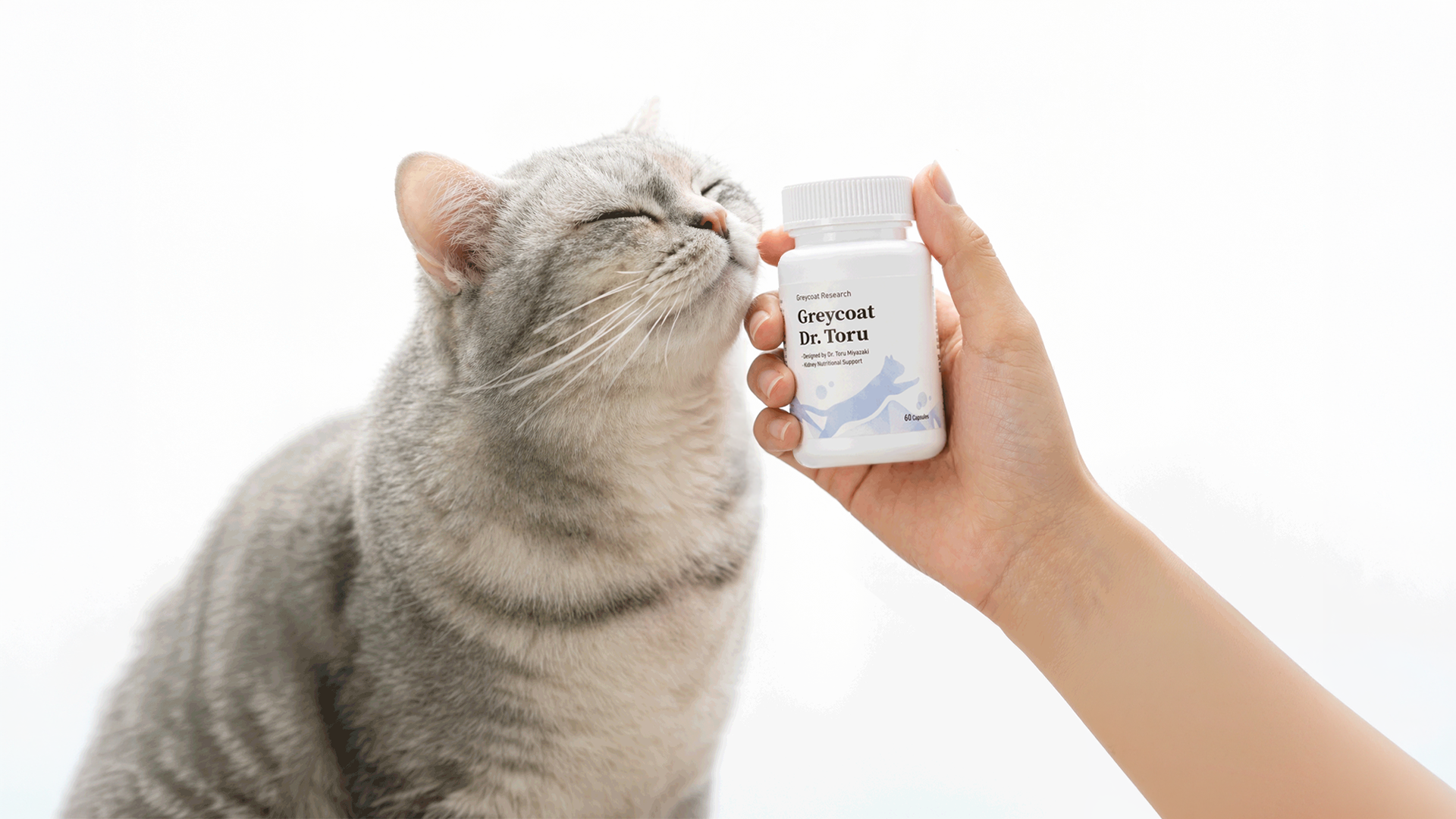
Greycoat Dr. Toru is Greycoat Research’s AIM-based nutritional support for cats, designed to be used as part of a daily kidney-conscious care routine alongside diet, hydration, and veterinary monitoring.
For Fred, Dr. Toru was considered as one part of a broader care routine that also included diet adjustment, hydration support, home observation, veterinary monitoring, Hydracare, Cosequin, and nutritional care.
Fred’s care routine was not based on one single action.
It was a combination of several connected parts.
What Fred’s Routine Included
Fred’s care routine included several connected parts.
Each part supported a different side of his daily care: diet, hydration, AIM-based nutritional support, home observation, and veterinary monitoring.
Diet and Hydration Support
Daryl started Fred on Purina Early Care and continued Hydracare.
He also added water to Fred’s wet food and checked Fred’s hydration regularly.
Daryl shared:
“Fred has not shown any need to begin fluids. I check his hydration regularly, and add water to his wet food as well.”
Rather than waiting for a major change, Daryl focused on supporting hydration and watching Fred’s daily condition closely.
Adding AIM-Based Support with Greycoat Dr. Toru
After reading more about kidney disease and Dr. Miyazaki’s AIM-related papers, Daryl completed a Greycoat Research consultation.
Through the consultation, he decided to begin a structured nutritional care routine that included Greycoat Dr. Toru as part of Fred’s daily kidney-conscious care.
Fred’s story should be understood as one individual care record.
His routine included multiple parts, and Dr. Toru was one part of that broader approach.
Daily Observation at Home
Daryl did not rely only on lab values.
He continued watching Fred’s daily condition, including:
- Appetite
- Vomiting
- Drinking habits
- Urine clump size
- Hydration
- Interest in play
- Interest in daily activities
- Overall energy
For many cat parents, this is where early changes first appear.
A cat may still have bloodwork values that look stable, but at home, the guardian may notice that something has changed.
Follow-Up Veterinary Monitoring
Daryl also returned to the veterinarian in February 2026 to have Fred’s blood pressure checked.
He shared:
“I did return in Feb 2026 and had his blood pressure checked while I handled him. Normal blood pressure.”
For cats with kidney concerns, veterinary monitoring remains essential.
Fred’s story is not about replacing veterinary care. It is about combining veterinary monitoring with careful daily observation and a structured home care routine.

What Daryl Reported: “I Had My Old Fred Back”
After Fred began his kidney care routine, Daryl started noticing changes within 2 to 3 weeks.
He shared:
“Within 2 to 3 weeks, I had my old Fred back. He is quite active now after 5 months on the protocol! No vomiting, great eater, active and interested in our daily activities, and smaller urine clumps in the box.”
For Daryl, this was the most meaningful part of Fred’s story.
- Fred was eating well again.
- He was more active.
- He showed more interest in daily life.
- Daryl reported no vomiting.
- His urine clumps became smaller.
Daryl described the change as:
“Amazing turnaround.”
These changes were meaningful because they were visible in Fred’s everyday life.
Not only in a lab report.
Not only in a single number.
But in the way Fred ate, moved, interacted, and participated in the home again.
What Fred’s Story Can Teach Cat Parents
Fred’s case is especially valuable because his creatinine and BUN did not dramatically change between January 2025 and January 2026.
That makes his story different from a simple before-and-after bloodwork story.
Instead, Fred’s story shows why cat parents should pay attention to subtle daily changes, especially in older cats.
Changes like these may be worth discussing with a veterinarian:
- Drinking more than usual
- Vomiting more often
- Sleeping more than before
- Eating with less enthusiasm
- Losing interest in play
- Producing larger or more frequent urine clumps
- Showing lower energy
- Acting less like themselves
These signs do not automatically mean a cat has kidney disease.
But they can be important clues.
In Fred’s case, Daryl noticed these changes and considered them together with bloodwork, diet, hydration, and veterinary monitoring.
That broader view helped him make more informed care decisions for Fred.
How Fred’s Story Changed Daryl’s Approach to Kidney-Conscious Care
Caring for Fred also changed the way Daryl thinks about long-term kidney-conscious care.
Daryl described early CKD care as “a truly challenging balancing act.”
Through Fred’s care journey, he came to believe that kidney-conscious care should begin early, with attention to diet, hydration, supplements, and even treat choices.
This experience also influenced how Daryl cares for his younger cat, Toby.
Toby is 6 years old, and Daryl has already begun thinking about kidney-conscious care for him as well.
He shared:
“I just worked with Greycoat consultations for my 6-year-old Toby, and put him on a new diet with lower phosphorus, added water and Hydracare to his diet, and started him on omegas, probiotics, and resveratrol. I will plan to consult again in time to see when it would be time to put him on the protocol.”
Fred’s story became more than one cat’s care record.
It changed how Daryl thinks about kidney health, diet, hydration, supplements, and long-term planning for both of his cats.
Daryl’s Message to Other Cat Parents
For other cat parents, Daryl shared this message:
“Always be reading, researching and watching your cats, and know there is always something to learn to help with the fine-tuning that the long-term stages of CKD require. Also, be as holistic as possible in your approach.”
This message reflects the heart of Fred’s story.
Long-term kidney care is rarely about one decision.
It often requires repeated observation, adjustment, veterinary guidance, and small daily choices that add up over time.
Why Fred’s Story Matters
Fred’s story is not simply a story about one lab value going up or down.
It is a story about a 14-year-old cat who was vomiting, drinking more, sleeping more, eating less enthusiastically, and acting less like himself — even though his creatinine and BUN had not changed from the previous year.
After 5 months of consistent care, Daryl felt that Fred’s daily condition had changed meaningfully.
He shared:
“Fred has done well, and I attribute that to the holistic approach and the more specifically targeted components of the products developed.”
Fred’s story reminds us that early kidney care often begins before a dramatic bloodwork change.
Sometimes, it begins when a guardian notices:
“My cat is drinking more.”
“My cat is vomiting more.”
“My cat is sleeping more.”
“My cat is eating differently.”
“My cat just does not seem like himself.”
For Fred, those small daily changes became the beginning of a more structured kidney care journey.
If Your Cat Is Showing Similar Changes
If your cat is drinking more than usual, vomiting more often, sleeping more, eating differently, or producing larger urine clumps, it may be worth discussing kidney screening with your veterinarian.
Bloodwork is important, but it is only one part of the picture.
Daily changes at home can also provide important context.
If you are thinking about adding AIM-based nutritional support to your cat’s daily kidney-conscious care routine, you can learn more about Greycoat Dr. Toru.
Greycoat Dr. Toru is designed for cats as part of daily nutritional kidney support alongside diet, hydration, and veterinary guidance.
[See Greycoat Dr. Toru for Daily Kidney Care]
Important Note
Fred’s record should be understood as one individual care story, not as proof that any supplement caused changes in bloodwork values or clinical condition.
Fred’s routine included veterinary monitoring, diet adjustment, hydration support, Hydracare, Cosequin, and nutritional care.
Results may vary depending on each cat’s individual condition. This story does not indicate a treatment effect.
Greycoat Dr. Toru is a nutritional supplement for cats. It is not intended to diagnose, treat, cure, or prevent disease.
The bloodwork values shared above are one individual case record. They should not be interpreted as evidence that any Greycoat Research product treats, prevents, or improves chronic kidney disease.
Diagnosis and treatment should always be guided by a veterinarian.
Kidney care early
can make a difference for your cat.
Alongside a renal diet, add AIM-based daily care with Dr. Toru.