알아보기
7-Year-Old Kkuruk’s Kidney Care Record: A Routine for a Cat Who Wouldn’t Take Capsules
By Greycoat Research Care Team
Based on a care story shared by Kkuruk’s guardian

For this month’s kidney care case, we are sharing the story of Kkuruk,
a 7-year-old spayed female Munchkin cat in Korea.
Kkuruk was born on September 15, 2018.
Her story began with elevated SDMA and BUN values in 2025. But for her guardian,
the real challenge was not only understanding the numbers on the report.
It was finding a daily kidney care routine that Kkuruk could actually accept.
Because Kkuruk strongly dislikes capsules, her guardian built the routine around wet food, snacks, opened capsules, and follow-up veterinary monitoring.
Her guardian shared:
“Personally, I feel that the supplements became a helpful part of her daily routine.
I’m sharing our experience in the hope that it may be useful to other guardians
caring for cats with kidney disease.”

Kkuruk’s record is one example of how kidney care at home often becomes
a combination of veterinary monitoring, daily observation, feeding flexibility,
and a routine that can be continued consistently.
Key Takeaways from Kkuruk’s Case
- Kkuruk’s SDMA was elevated in August and September 2025.
- Her BUN was also elevated on the September 2025 test report.
- Later follow-up reports in October 2025, November 2025, and February 2026 showed kidney-related values within the normal ranges shown on the reports.
- Her guardian continued follow-up monitoring while building a daily care routine at home.
- Because Kkuruk strongly dislikes capsules, her guardian opened the capsules and mixed the contents into wet food or snacks.
- Greycoat Dr. Toru, Greycoat Probiotics, and Greycoat Omega-3 became part of Kkuruk’s daily kidney care routine.
Kkuruk at a Glance

| Category | Details |
| Name | Kkuruk |
| Age | 7 years old |
| Sex | Female, spayed |
| Breed | Munchkin |
| Date of Birth | September 15, 2018 |
| Body Weight | 3.4 kg, recorded on November 22, 2025 |
| Kidney Care Status | Early kidney care after elevated SDMA and BUN values were noted in 2025 |
| Care Routine | Greycoat Dr. Toru, Greycoat Probiotics, and Greycoat Omega-3, together with veterinary monitoring |
When Kkuruk’s Kidney Values Raised Concern

In 2025, Kkuruk’s kidney-related bloodwork began to raise concern.
On August 2, 2025, her SDMA was recorded at 20.1 µg/dL.
On September 12, 2025, her SDMA was recorded at 19.2 µg/dL,
above the normal range shown on the report.
Her BUN was also recorded at 44.2 mg/dL, above the normal range shown on that report. Her creatinine was 1.69 mg/dL, within the normal range shown on the report.
Kkuruk’s guardian explained that Kkuruk had been receiving veterinary medication during the earlier period. After that period, her guardian continued daily home care with Greycoat Dr. Toru and Greycoat Probiotics while maintaining follow-up monitoring
through the veterinary clinic.
Her guardian shared that after the earlier medication period, she continued Kkuruk’s daily care with Dr. Toru and Probiotics.
We share this as Kkuruk’s guardian’s personal care experience. Kkuruk’s record should be understood as one individual care timeline that included veterinary medication during the earlier period, follow-up bloodwork, daily home care, and nutritional support.
Kkuruk’s Follow-Up Bloodwork


Kkuruk’s guardian continued to follow her kidney-related values over time.
Rather than relying on one result alone, her guardian monitored the broader pattern through repeated testing.
| Test Item | August 2, 2025 | September 12, 2025 | October 20, 2025 | November 22, 2025 | February 21, 2026 | Observation |
| SDMA | 20.1 HIGH | 19.2 HIGH | 10 | 7 | 9 | Elevated in August and September, then within the normal range in later follow-ups |
| Creatinine | 1.66 | 1.69 | 1.7 | 1.3 | 1.7 | Stayed within the normal range shown on each report |
| BUN | 28.4 | 44.2 HIGH | 32 | 30 | 27 | High in September, then within the normal range in later follow-ups |
| Phosphorus | — | — | 3.8 | 4.2 | 5.3 | Within the normal range shown on the available reports |
Normal ranges may vary by laboratory and report.
Values are shown as recorded in Kkuruk’s submitted test reports.
In August and September 2025, Kkuruk’s SDMA was above the normal range
shown on the reports. Her BUN was also elevated in September.
Later follow-up reports in October, November, and February showed these
kidney-related values within the normal ranges shown on the reports.
Because Kkuruk’s earlier care also included veterinary medication and follow-up monitoring, these lab records should be understood as one individual care timeline.
They should not be interpreted as evidence that any single supplement caused
the later bloodwork results.
Kkuruk’s guardian described the follow-up results positively:
“As you can see from the test results, in November, her kidney values returned to the normal range, and the test she had in February this year was also all normal. We have continued caring for her in the same way until now, and she is scheduled for another health checkup around next month. Since her condition is also good,
I think this next test result may probably be similar too.”
The Daily Challenge: A Routine Kkuruk Could Actually Accept
For Kkuruk, the most important part of daily care was whether she would actually accept the routine.
Some cats readily accept capsules, while others refuse them completely.
Kkuruk strongly dislikes capsules, so her guardian adjusted the routine around
Kkuruk’s feeding preferences.
Instead of forcing capsules, her guardian opened them and mixed the contents into
wet food or snacks.
Kkuruk ate well when the contents were mixed into wet food, which helped make
daily care easier to continue.
A care plan can look good on paper, but if the cat refuses it, it becomes difficult to maintain. Kkuruk’s guardian found a way to make the routine fit Kkuruk’s real daily behavior.

Morning: Dr. Toru and Probiotics with Wet Food
In the morning, Kkuruk’s guardian gives Greycoat Dr. Toru and Greycoat Probiotics with wet food.
Her guardian wrote:
“In the morning, I mix 1 Dr. Toru and 1 Probiotic into wet food and feed her that way. Since she does not take pills, I remove the capsules before giving them.”
This adjustment helped make the routine more practical for Kkuruk.
Because Kkuruk does not like capsules, opening the capsules and mixing the contents into wet food became an important part of the care routine. Her guardian shared that Kkuruk ate well this way, making the routine easier to maintain without forcing capsule medication.
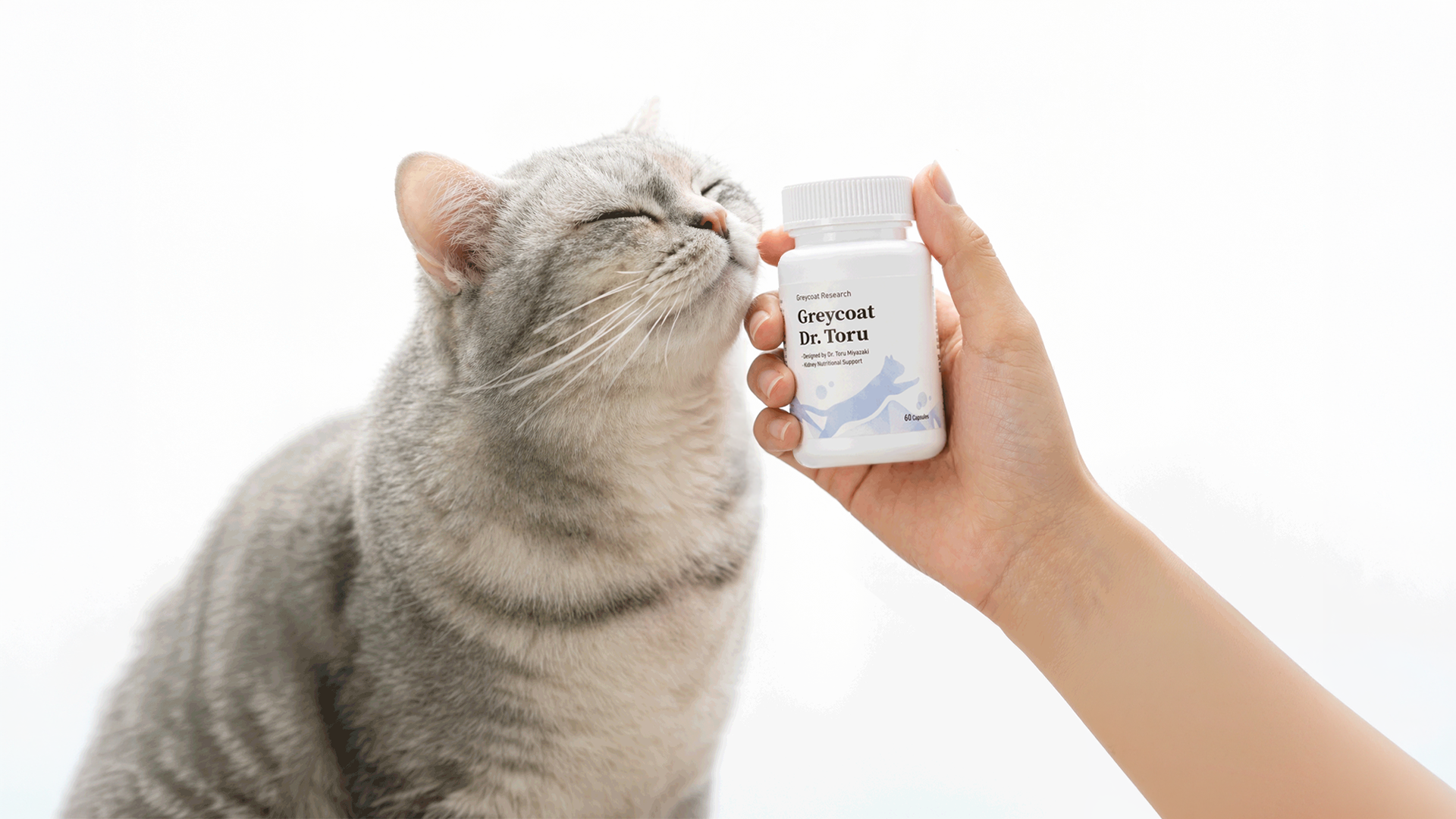
Greycoat Dr. Toru is Greycoat Research’s AIM-based daily kidney support for cats, designed to be used as part of a daily kidney care routine alongside diet, hydration, and veterinary monitoring.
In Kkuruk’s case, Dr. Toru was not used as a replacement for veterinary care. It was used as one part of a broader daily routine that also included Greycoat Probiotics, Greycoat Omega-3, feeding adjustments, home observation, and follow-up bloodwork.
Evening: Dr. Toru and Omega-3 with a Snack
In the evening, Kkuruk receives Greycoat Dr. Toru together with Greycoat Omega-3.
Her guardian wrote:
“In the evening, I mix 1 Dr. Toru and 1 Omega-3 into a snack and feed it to her.”
Kkuruk had previously been taking another company’s omega-3 product.
After Greycoat Research launched its Omega-3, her guardian purchased it and transitioned to the Greycoat product for her current supply.
Omega-3 was used as part of Kkuruk’s broader nutritional routine, not as a replacement for veterinary care.
Why Feeding Convenience Mattered
Kkuruk’s guardian also explained why Greycoat Probiotics became a practical part of the routine.
After the veterinarian recommended another product for ongoing care,
the guardian felt it might not be the best fit for Kkuruk because it needed to be given
as an intact capsule. Kkuruk strongly dislikes capsule medication.
Her guardian wrote:
“For reference, the veterinarian recommended another brand’s product for ongoing care afterward, but since it has to be given as a whole capsule, I thought it would not be suitable for my cat, who really hates capsule medication.
Then I learned about Probiotics and mixed the powder into snacks or wet food, and she ate it really well.
Maybe because it has no taste or smell, she just licked it all clean. I think cats who have difficulty taking pills could be managed much more easily this way.
In the beginning, I actually managed her with Probiotics first, before Dr. Toru.”

For Kkuruk, feeding convenience was not a small detail. It was one of the reasons the routine could be continued consistently.
When a cat accepts the routine without stress, daily care becomes more realistic for both the cat and the guardian.
What Kkuruk’s Guardian Reported
For Kkuruk’s guardian, the most meaningful part was not only the numbers on the report.
It was also the feeling that the routine was manageable at home.
Her guardian shared that Kkuruk ate well when the contents were mixed into wet food, and that her condition seemed good at home.
Kkuruk’s follow-up reports in November 2025 and February 2026 showed kidney-related values within the normal ranges shown on the reports, and her guardian continued the same care routine while planning another health checkup.
We share this as Kkuruk’s guardian’s personal experience. It should not be interpreted as proof that any supplement caused a change in bloodwork values or clinical condition.
What Cat Parents Can Take from Kkuruk’s Story
Kkuruk’s story is not simply about one number changing.
It is a story about noticing kidney-related concerns, following up with veterinary testing, and building a daily routine that the cat could actually accept.
For cat parents, Kkuruk’s story offers a few practical reminders:
- Recheck abnormal kidney-related values with your veterinarian.
- Do not rely on one test result alone.
- Build a routine your cat can realistically accept.
- If your cat dislikes capsules, ask your veterinarian whether opening capsules or mixing contents into food is appropriate for your cat’s care plan.
- Continue watching appetite, weight, hydration, feeding tolerance, and overall behavior at home.
A Simple First Step: Greycoat Dr. Toru
Kkuruk’s daily care routine was built around what she could actually accept.
If you are just beginning your cat’s kidney care journey, you do not need to start with everything at once.
Greycoat Dr. Toru is an easy way to add AIM-based daily kidney support to your cat’s current daily care, alongside diet, hydration, and veterinary monitoring.

[Start with Greycoat Dr. Toru]
Important Note
Kkuruk’s record is one individual care story.
It should not be interpreted as evidence that any supplement caused changes in bloodwork values or clinical condition.
Kkuruk’s routine included veterinary medication during the earlier period, veterinary monitoring, Greycoat Dr. Toru, Greycoat Probiotics, Greycoat Omega-3, and daily home care.
Results may vary depending on each cat’s individual condition.
Greycoat Dr. Toru is a nutritional supplement for cats. It is not intended to diagnose, treat, cure, or prevent any disease.
Diagnosis, treatment, medication, diet changes, and kidney disease management should always be guided by a veterinarian.
Kidney care early
can make a difference for your cat.
Alongside a renal diet, add AIM-based daily care with Dr. Toru.